Nurturing Creativity and Curiosity: Curriculum in the Middle Grades
Reimagining Grades 7-12
At Slate School, we reimagine the Upper Grades. Slate Upper School has 15 students per grade, beginning with Grade 7 in Fall 2024, and growing to a total of 90 students in grades 7-12 in Fall 2029. When we have a full cohort of K-12 students, we will have 160 total students in the school.
Our students explore widely, dive deeply, research, investigate, and collaborate. Their journey is guided by faculty and advisors who are creative thinkers who transcend typical rote approaches to teaching. While attentive to benchmarks and a robust established curriculum, faculty are flexible to allow course direction to be learner-centered and therefore driven by the students’ own work and ideas. All students also put learning into action by engaging daily in their original research project. The project selection is completed in trimester approaches, with the possibility of multiple trimesters to be stringed together into a year-long project, if desired.
“Knowing how to nurture and guide students’ curiosity is the gift of all great teachers. They do that by encouraging students to investigate and inquire for themselves, by posing questions rather than only giving answers, and by challenging them to push their thinking deeper by looking further.”
— Sir Ken Robinson
Empowered Learning
We are inspired by education thought leaders Sir Ken Robinson, Tony Wagner, Ted Dintersmith, and Wendy Ostroff, among others. We envision a world where education focuses on curiosity, creativity, critical thinking, communication, collaboration, compassion, and citizenship. As opposed to siloed subjects of learning, Slate Lower and Upper Schools integrate the disciplines together, and the spaces in both schools are designed to support these unique educational philosophies. Students engage in deliberate practice to build and demonstrate their skills and knowledge, while developing a portfolio demonstrating the breadth and depth of their learning, competency, and expertise. Students are prepared to thrive in college and beyond.
Grade 7-8 Scope of the Day
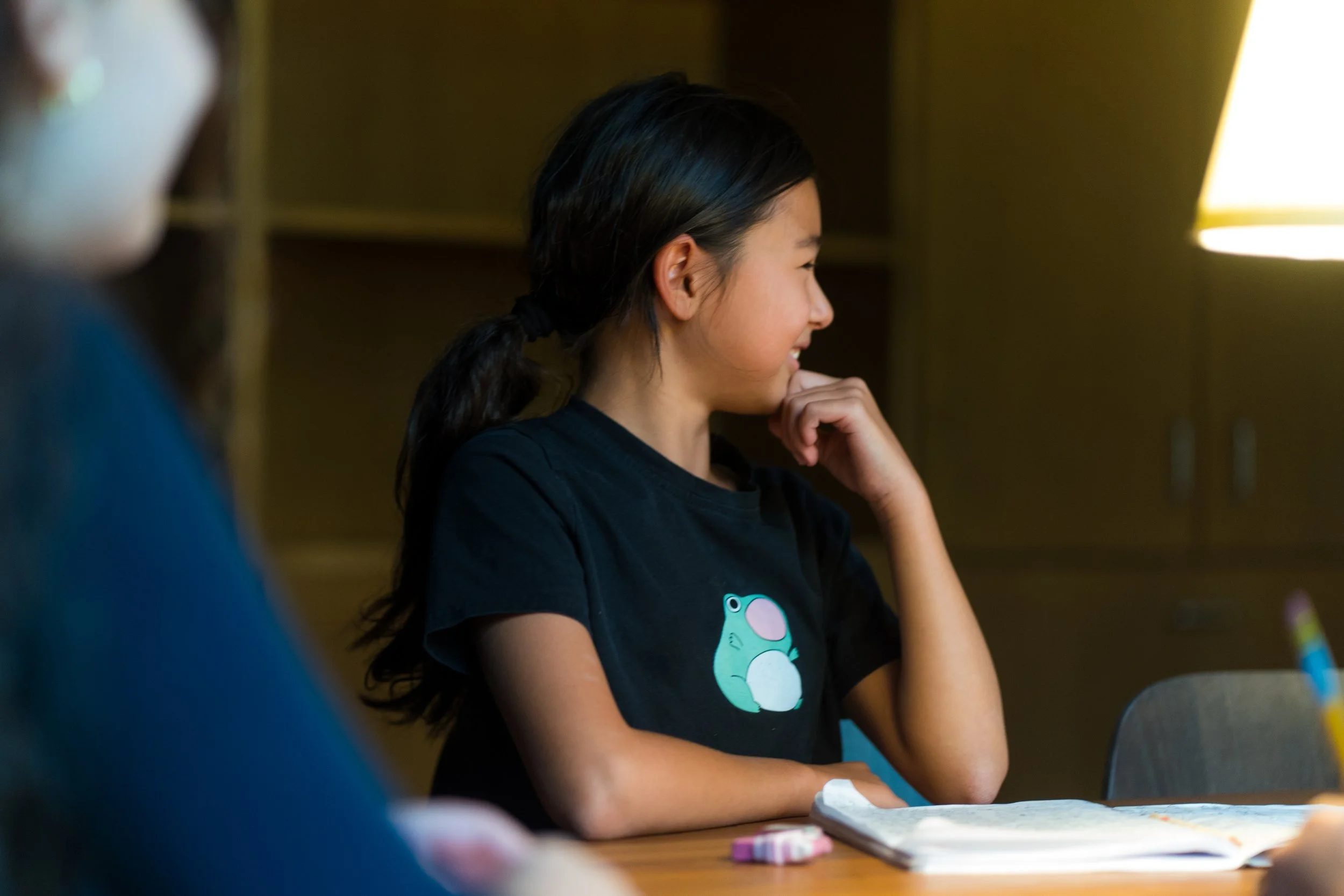
In Grades 7 and 8 at Slate School, students grow their autonomy, skills, and learning. With a focus on building competency in autonomy, students take ownership of their learning, seek to challenge themselves, and are guided by faculty advisors who support each student to develop skills towards work habits and interpersonal skills.
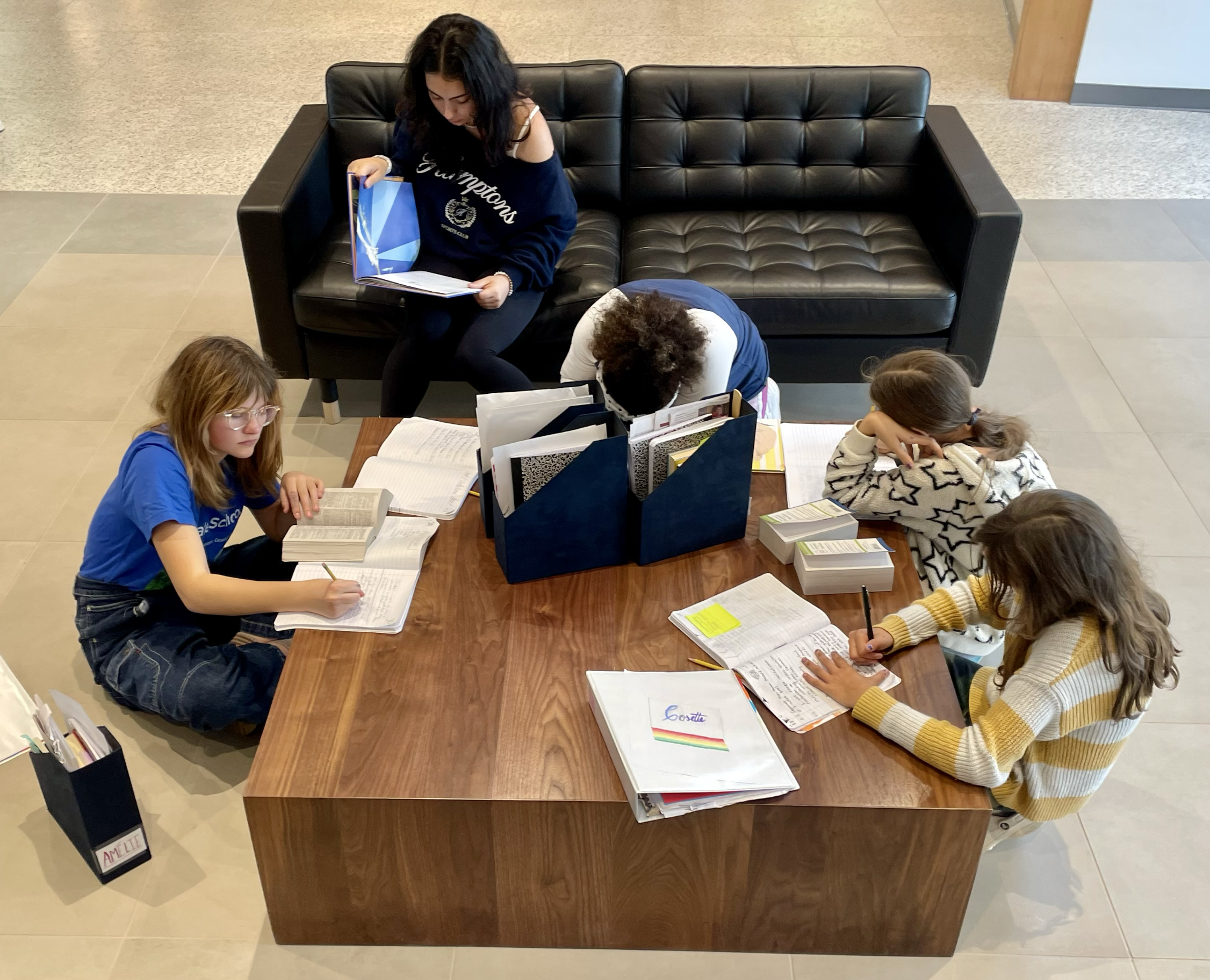
Throughout the day, students have opportunities to work independently, in small groups, and in whole-class Studios. Slate School supports each student to wonder, engage, deeply learn, and flourish in a learner-centered and academically-rigorous environment. We assess our students robustly and authentically, focusing on curricular benchmarks and essential competencies rather than relying on a traditional grading scale that can be arbitrary. Students reflect on and thoughtfully produce examples of their learning, and they develop portfolios of meaningful work.
In the middle grades at Slate School, students participate in a Studio Model that emphasizes a project-based, interdisciplinary approach with real-world connections in a collaborative setting. Courses are designed by educators to be interdisciplinary and are tailored to meet competency goals and student interests. We seamlessly integrate English, History, Math, and Science, ensuring that content and skills are always interconnected and not learned in isolation.
Grade 7-8 Curricular Overview
Slate School's curriculum is thoroughly researched and expertly designed to deeply engage and challenge students in all disciplines. We do not use traditional textbooks, which often provide only superficial and rote understanding about topics. Instead, we use a diverse range of curated resources, including national newspapers, articles from leading journals, books, documentaries, primary sources, insights from experts, and experiences. Our students engage in learning through collaborative and independent projects that are highly relevant to both them and their communities.
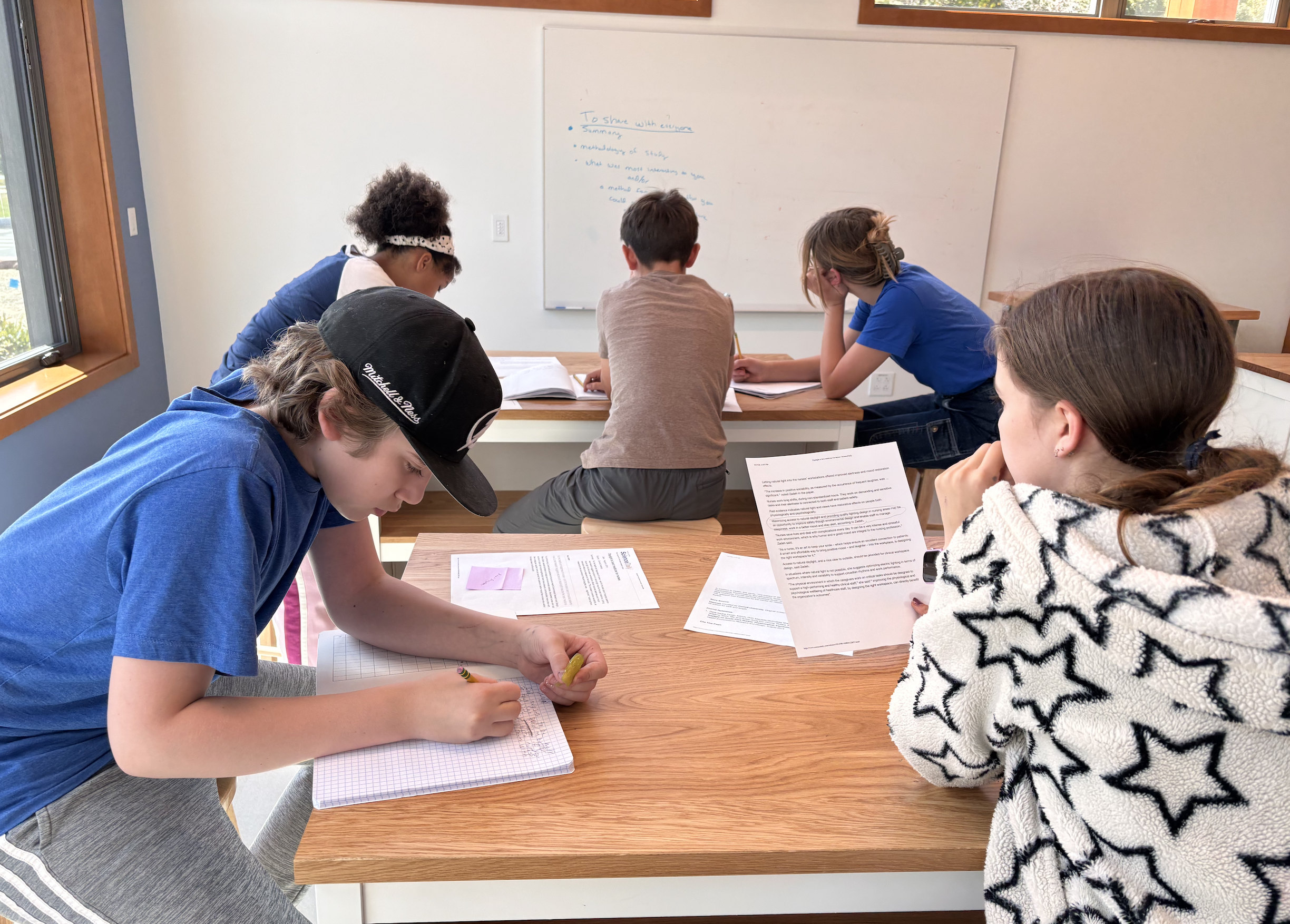
In our Studio Model, we start by exploring a topic or problem that requires deeper understanding. First, we work as a whole group to clarify our purpose by reading articles and conducting research. Next, we divide into smaller collaborative groups to further investigate specific aspects of the topic, frequently sharing our findings as we create a document that reflects our new understanding. This process not only helps us learn about various issues but also encourages us to develop ideas to address global challenges. For example, in a recent Studio focused on Happiness, students explored methods for understanding happiness, the history of emotional well-being, and biases that can hinder true happiness. They then applied their insights to deepen their understanding of Slate School’s core values: Friends, For Others, Forgiveness, and Gratitude. In Grade 7 and 8 Studios, students delve into happiness, world history from ancient to modern times, government, immigration and migration, conflict in the 20th century, and the United Nations. A recent Studio, for example, delved into our election cycle, examining local, national, and international issues. This Studio culminated with a field trip to the Quinnipiac Polling Institute on Election Day 2024. During Winter 2025, students engaged in a launch about migrations of humans as well as animals. Each of the Studios integrate all disciplines, including historical perspectives and social sciences.
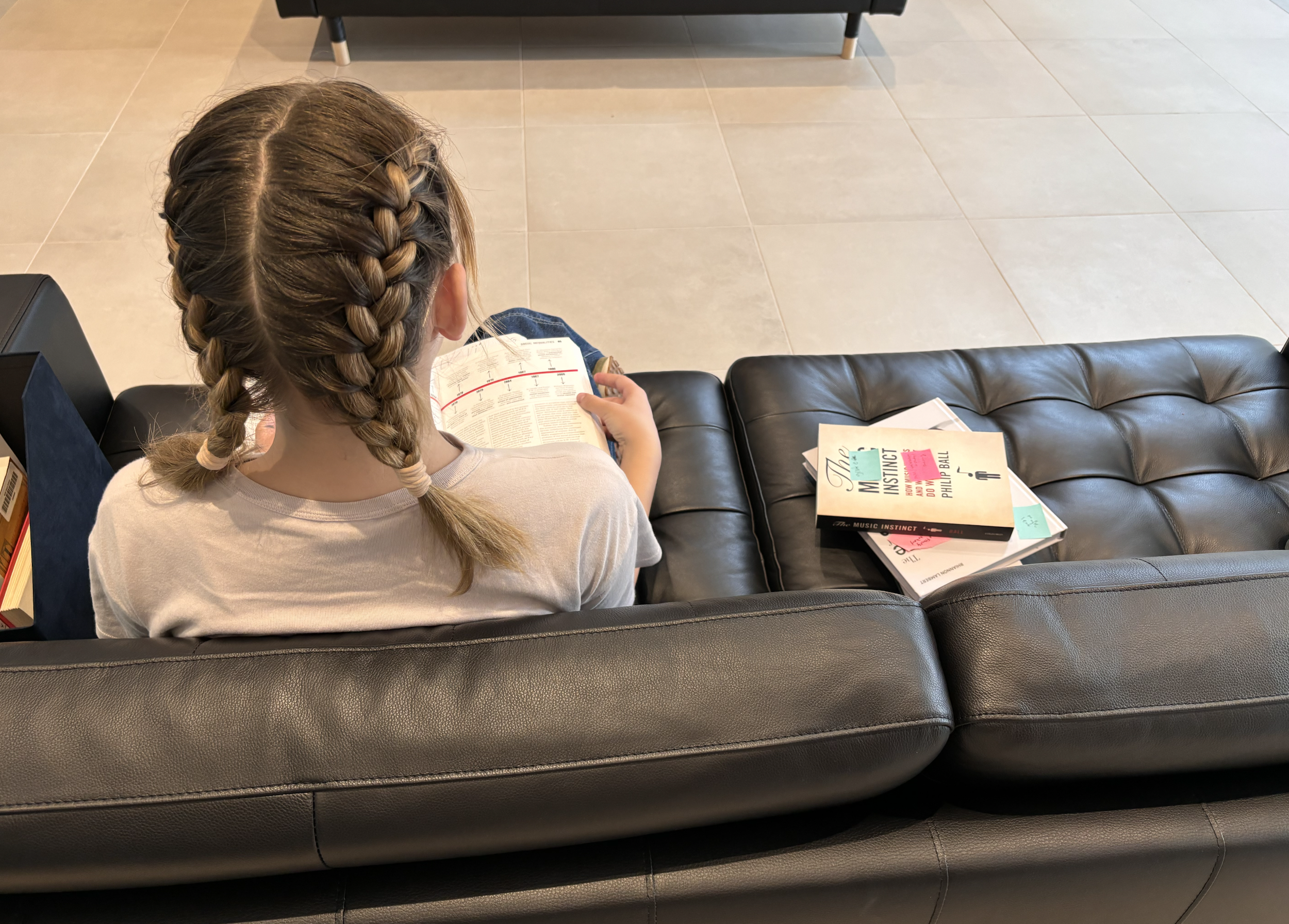
Literacy is at the heart of much of what our students do and learn. Our students each have personal books of their choice that they read and contemplate, while also reading a book that the entire class explores together. Both types of texts provide opportunities for building greater understanding of author’s craft, thematic development, story grammar, and most of all, understanding differing perspectives. Students also routinely write about their reading and have opportunities to apply the craft that they encounter in these model texts.
At Slate Upper School, we’ve adopted the Integrated Math approach as the foundation of our mathematics instruction. Rather than isolating algebra and geometry, Integrated Math merges all areas of math, reflecting how these subjects coexist in the real world. Our unique approach is interdisciplinary, interactive, experiential, and relevant, with new concepts often introduced alongside their historical context and applications. For example, students engage with algebraic equations and graphing when dropping balls in free fall to calculate the acceleration of gravity. They also create saline solutions that match the world's bodies of water, and through that exploration, they explore percentage concentrations, buoyancy, and other related concepts. This hands-on, small-group learning allows them to apply mathematical ideas to authentic situations. Read about recent Grade 7 mathematical experiences: “Interdisciplinary Exploration of Patterns and the Golden Ratio” and “From Ramps to Renaissance Art: The Power of Slope”.
Similarly, our Science instruction is interdisciplinary and experiential, often integrated with math, history, social sciences, and the arts. Reading and writing skills are also essential components of our science curriculum. Students frequently read, write about, and discuss published science journal articles, which engages them in cutting-edge knowledge while learning about the scientific method, data analysis, and scientific writing. Experiments and laboratory work are also key parts of their learning experience. Read about a recent Grade 7 experience at the intersections of math and science, “Exploring the Gravity Discoveries of Galileo, Newton, and Cavendish”. We also have a blog about a recent trimester of the 8th grade Think Lab course: “From Factfulness to October Sky: Interdisciplinary Learning From Data, Texts, and Historic Perspectives.”
Students in the middle grades engage in direct Spanish language instruction, focusing on written and verbal communication, as well as cultural understandings.
Slate School’s project-based model has trimester approaches in the middle grades. Students select three project topics each year which they pursue as in-depth independent studies. Led by student curiosity, students read books and scholarly articles, interview experts, and communicate their learning in a panel presentation, slide presentation, or poster presentation. Student project topics in the middle grades have ranged from Salem Witch Trials and Great Molasses Flood to Titanic and an exploration about whether life could exist on Mars.
Advising
Students identify and apply competencies from our curriculum to establish weekly goals for growth and mastery in consultation with their advisors. Advisors meet with individual advisees for coaching twice per week. Each session begins with the student’s reflection on progress and challenges, which leads to wise goal setting and refinement of the goals in progress. The week’s goals also include areas where students are working to grow their autonomy. Students receive direct instruction in Time Management, Goal Management, Initiative, Self Knowledge, Collaboration, and Communication as they build these skills for successful life-long learning.
What Others Are Saying
Slate School is a unique innovator. We draw inspiration from other schools and thinkers in the country. Here's what some of them say about this kind of learning:
“We are deeply invested in the entirety of students and believe they are more than just receptacles to be filled with knowledge and skills.”—Embark Education, Denver
“We believe when young people can see relevance in their education, build connections to opportunity through their studies, and genuinely care for one another, they are equipped to be a force for good—for themselves, their community, and the world.”—GCE Lab School, Chicago
“College admissions officers have gone out of their way to tell us how much they value NuVu’s curriculum and learning model. They understand that our students are well ahead of their peers with regard to critical thinking, creative confidence, collaborative skills, technical experience and capacity to grapple with complex, real-world issues.”—NuVu Innovation School
“Ours is not a desk and chalkboard institution but rather a center, a laboratory, where students develop ideas and understanding, pursue passions and dreams."—Bennett Day School, Chicago
"Students engage in work that matters to them, to their teachers, and to the world outside of school. Students connect their studies to the world through fieldwork, community service, internships, and consultation with outside experts. Our facilities are collaborative workplaces with small-group learning and project areas, relevant technology, and common spaces where artwork, prototypes, and other artifacts of student thinking are created and displayed.”—High Tech High, California