Interdisciplinary, Deep Learning: The Unique High School Curriculum
A Unique High School Experience
Slate School is intentionally expanding to include Grades 9-12, beginning with Grade 9 in Fall 2026 and adding one grade each year. We have designed a curiosity-driven high school experience that ensures deep learning, close faculty mentorship, and a highly personalized experience for each student.
At Slate School, high school is designed around two interconnected experiences: building essential skills and applying them to meaningful, real-world questions. Students take Foundation Courses to develop core skills in mathematics, science, writing, and language, while also engaging in interdisciplinary Application Courses.
Across all four years, students:
Build strong academic foundations through honors-level courses as well as opportunities for college-level courses
Engage in a sequence of interdisciplinary core courses (Foundation and Application Courses) that connect disciplines rather than siloing them
Design and pursue independent research and projects based on their passions
Pursue unique elective courses beginning in 9th grade
Develop a portfolio of work demonstrating depth, mastery, and original thinking
With small classes and close faculty mentorship, each student’s interests and goals are supported within a rigorous and carefully designed academic framework. They learn how to think, they connect ideas, and they apply their knowledge in meaningful ways.
Foundation and Application Courses
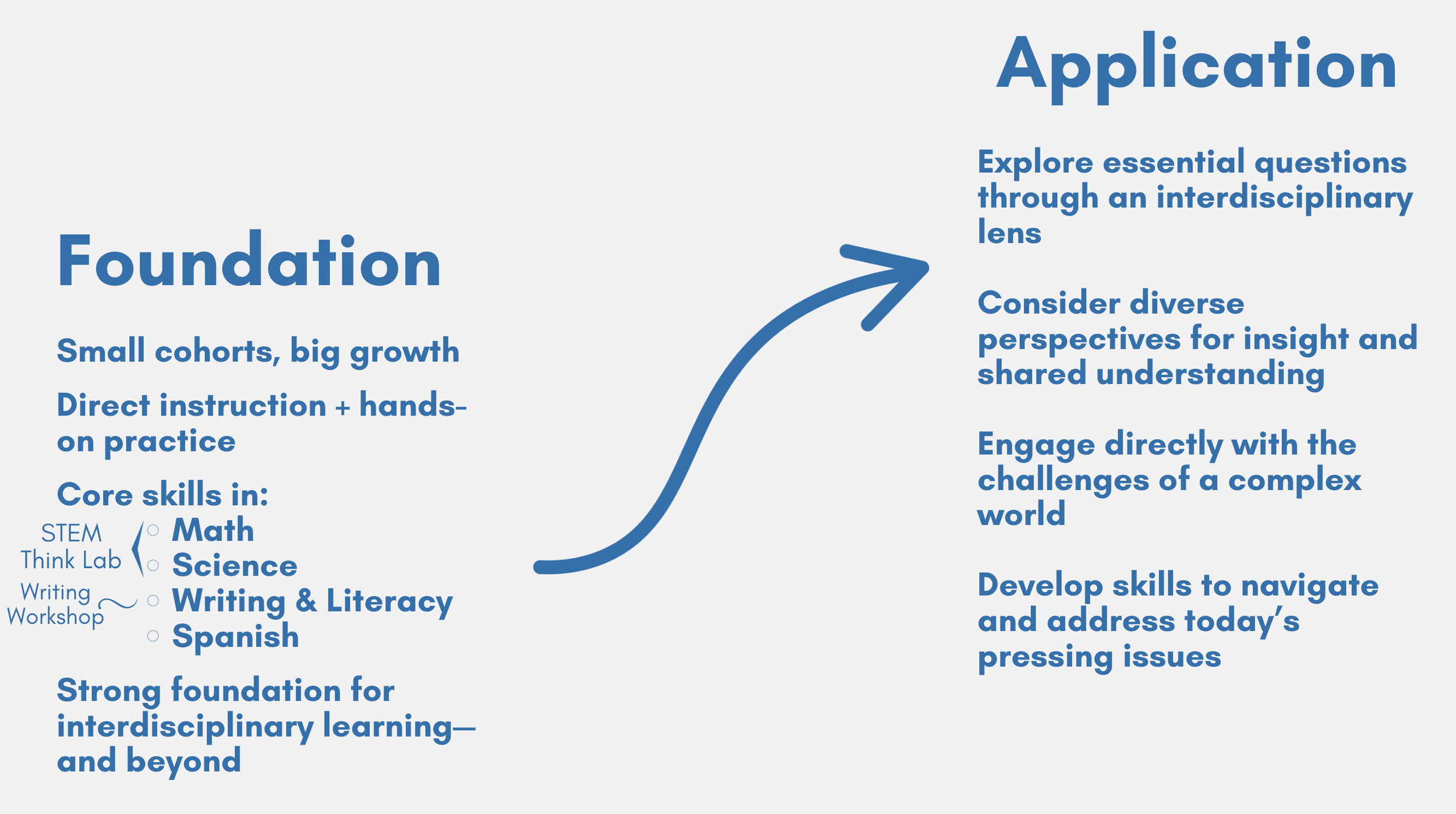
Foundation and Application Courses work together to create a balanced, purposeful education. Foundation courses alone may provide ability without direction. Application courses alone may spark questions without the tools to pursue answers. Together, these courses ensure students gain essential capacities and apply them to big questions and ideas. In practice, students combine foundation and application to tackle real-world challenges.
Grade 9-12 Foundation Courses
STEM Think Lab: In STEM Think Lab, students use mathematics and science to investigate questions that emerge from data, texts, and historic perspectives. Students are deeply engaged in interdisciplinary mathematical and scientific learning rooted in real-world problem solving. The course nurtures students to think mathematically and scientifically about authentic issues, while cultivating their ability to apply understanding to original ideas, pursuits, and solutions. In Grade 9 (or in Grade 8 for accelerated students), students pursue STEM Think Lab I, which includes both the Integrated Math 1 curriculum, as well as scientific learning in biology, chemistry, physics, and environmental science. Learning is typically grounded in a non-fiction text that serves as the foundation of learning for each trimester. Read about STEM Think Lab I for Grade 8 accelerated students in 2025-2026 here.
In the next academic year, students pursue STEM Think Lab II, which furthers mathematical understandings in the Integrated Math 2 curriculum, as well as continuing to grow depth and breadth of understanding in biology, chemistry, physics, and environmental science. Students continue this sequence of study throughout their four years of high school (STEM Think Lab I, II, III, IV, V). Integrated Math is a curriculum that integrates algebra and geometry, as opposed to siloed courses in each. STEM Think Lab IV includes precalculus. Students who begin Grade 9 in STEM Think Lab II — or who accelerate in mathematics through other avenues — are able to pursue calculus in STEM Think Lab V.
Writing Workshop: Each year of high school, students develop strong composition skills through practice, feedback, and revision. Students grow their writing across a range of forms, including personal narratives, analytical essays, persuasive writing, thesis-driven essays, and creative pieces. Through writing composition, peer discussions, and instructor feedback, students gain confidence in expressing their ideas and shaping their unique voices as writers. This course follows a four-year sequence (Writing Workshop I, II, III, IV) as students build increasing sophistication in their writing and critical thinking.
Spanish: The Spanish programs includes a four-year sequence designed to develop student proficiency in listening, speaking, reading, and writing, as well as cultural understanding about the Spanish-speaking world. Students engage in conversational practice, interactive activities, readings, written assignments, and oral presentations. Students engage in Spanish I, II, III, and IV throughout their high school years. Students who are accelerated or fluent have opportunities to study Spanish Literature and other advanced courses of study.
Grade 9-12 Application Courses at the Intersections
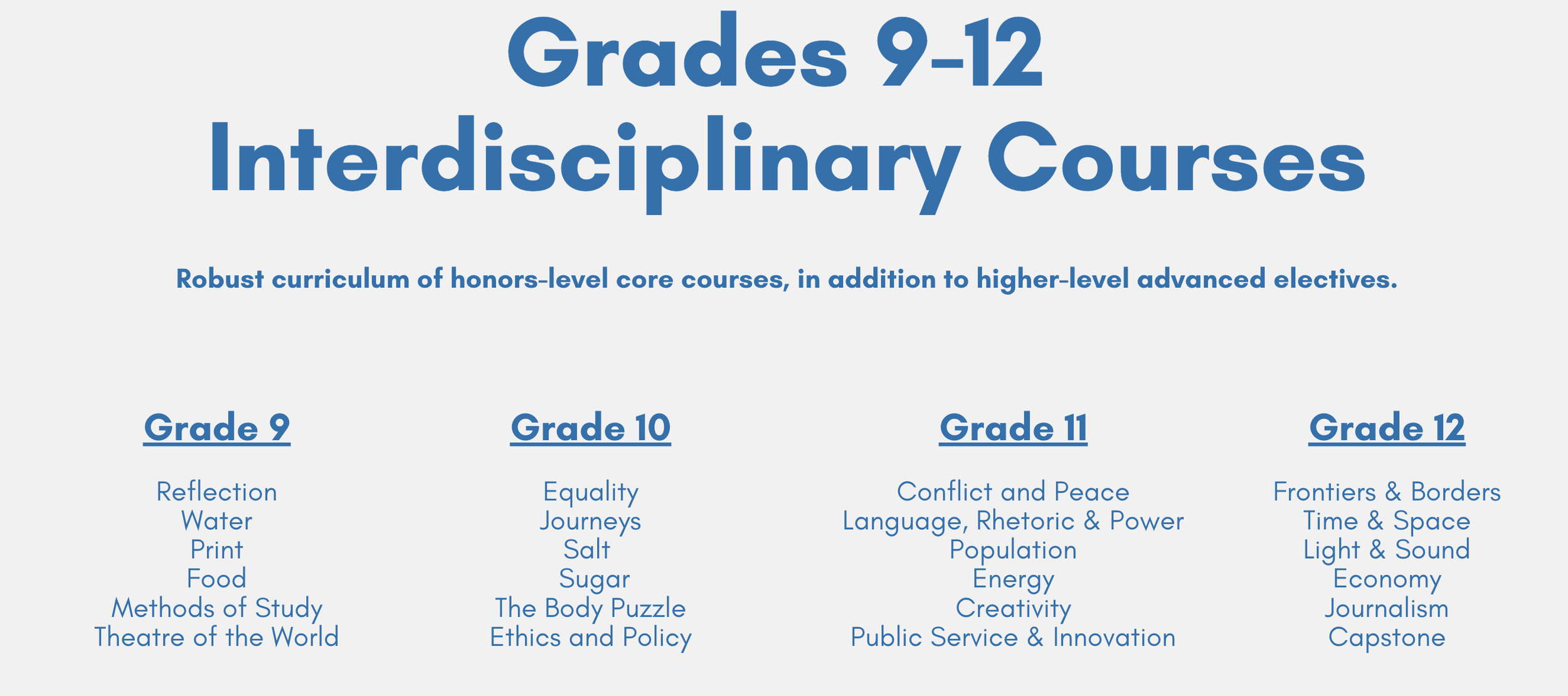
Application courses integrate history, literature, social sciences, mathematics, and science through thematic study. Students are required to successfully complete all 24 of these core courses during their high school years.
In the Upper Grades, we continue to find connections across disciplines. Our courses include Salt, Ethics and Policy, Theatre of the World, Equality, Food, Thought, among many other innovative and intriguing courses. Each course is honors level and interdisciplinary, and students integrate all of the disciplines through the unique and interesting non-siloed course lens.
Each of our non-siloed courses is designed around benchmarks for in-depth study, with students learning through reading, writing, discussion, collaboration, problem solving, and projects. Course titles include Thought, Food, Reflection, Methods of Study within Scholar Projects, Water, Complexity and Unintended Consequences, Theatre of the World, Equality, Salt, Sugar, Print, Journeys, Design and Engineering, Ethics and Policy, The Body Puzzle, Frontiers and Borders, Light and Sound, among many others.
Through these interdisciplinary courses, Slate School students are enlivened and challenged. They far exceed the typical expectations of high school through the authentic, applicable, and multidisciplinary understandings. Each course culminates with a project that identifies problems and develops ideas for solutions. Our students are “solutionaries;” They apply their learning to create authentic solutions to real issues.
In addition to their courses, each student designs and pursues independent projects and research studies. Many of these students integrate work from the Idea Lab space into their projects.
Several Grade 9-12 Application Course Descriptions
Water: Water is the resource that runs the world. There is nothing more essential, and few things more complex. Our work will grow from an explicit understanding of the science of water, the mathematics of its scarcity and abundance, and how it has influenced and been influenced by the development of human civilizations.
Journeys: Experience important stories shared across time to explore their relevance to our lives today. Tales of immigration, conflict, injustice, heroism, and innovation, travel through books, oral history, art, music, and primary sources to help us understand where we come from and where we're going.
Salt: Salt is essential and omnipresent. NaCl’s crystals are translucent, its uses are myriad, and its availability has been critical to civilization. Salt holds an important place in religious rituals worldwide. Explore salt chemistry to understand the commonalities and differences between the widely-known and edible table salt (NaCl) and the myriad of other inorganic salts.
Sugar: Explore sugar from discovery to current day. How has sugar’s reputation through history evolved, and what power dynamics have been involved? Explore sugar production, the chemistry of sugar, and the processing of sugars by the body.
The Body Puzzle: The body is an interconnected and interdependent web of complex systems. The historical and philosophical explorations of the human body offer an understanding for all of the science that we've learned from and about the body, and all that remains unknown and unanswered. How do we critically think about the body's systems, while maintaining humility in not knowing everything about how the body works?
Complexity and Unintended Consequences: The problems of our world are complex and interconnected. How do we respond to these challenges with the greatest foresight? Where does the balance lie between quick and decisive action and steady and contemplative response? Apply models of problem solving from the diversity of thought around the globe to find your personal answers to these questions.
Thought: The brain's storage capacity is considered virtually unlimited, so it should not be surprising that it is the source of great innovation, spectacular failure, immense creativity, and madness. Dig into this most complex topic to consider the ideas of history's greatest minds and the remarkable science of this unique organ.
Food: Join in the contemplation of a topic that brings biology, anthropology, chemistry, economics, evolution, physics, agriculture, politics, and religion to the table.
Electives
During each trimester of their high school years, students have opportunities to engage in one or more electives, which are offered on a rotating basis. Planned electives include:
Art: Studio Art, Painting and Art History, Photography
Music: Musical Composition, Choir, Soundtrack of the World
Writing: Creative Writing, Playwriting, Story Alive: Documentary Screenwriting
Debate and Law: Speech and Debate, and Law, Justice, and Mock Trial
Sciences: Advanced Independent Science Research, Environmental Science, Design and Engineering
Math: Sports Statistics, Coding
Independent Study: Students may pursue advanced curricular courses of study, mentored by both a Slate School educator as well as a professional mentor in the field of study.
Advanced Independent Research
Beginning in Grade 7, students at Slate School have the opportunity to design and pursue independent scientific research, with the option to present their work at the Connecticut Science & Engineering Fair and the Connecticut Invention Convention. High school students also have opportunities to present research at other events, such as the CT Junior Science & Humanities Symposium and Connecticut History Day.
In 2025-2026, an 8th grade student earned 2nd place in the Life Sciences Awards at the statewide Connecticut Science & Engineering Fair as well as 3rd place in the Pfizer Computational Biology and Bioinformatics Awards. Hosted at Quinnipiac University, the CT Science & Engineering Fair convenes hundreds of middle and high school students from throughout the state each year, and students present their projects to judges and industry sponsors. The student’s research project, "A Microbiology Study of Ancient and Modern Flours: Comparing Microbial and Chemical Changes in Leavening Systems", involved months of experimentation and analysis, including 18 different flour mixtures sampled over 10 days, 164 petri dishes, dozens of CO₂ captures using balloons, and countless pH strip tests.
In 2024-2025, a 7th grader earned 2nd place in Life Sciences at the statewide Connecticut Science & Engineering Fair for his research entitled, "Petri Dish Experiments Exploring Bacteria Growth in Soil Samples With and Without Nitrogen-Fixing Bacteria.” His work was also recognized as a Finalist for the Alexion Biotechnology Awards.
That same year, a 7th grader invented the Child Safe HotLock, which received the Connecticut Fire Marshals Award at the Connecticut Invention Convention.
A Typical Grade 9 Day
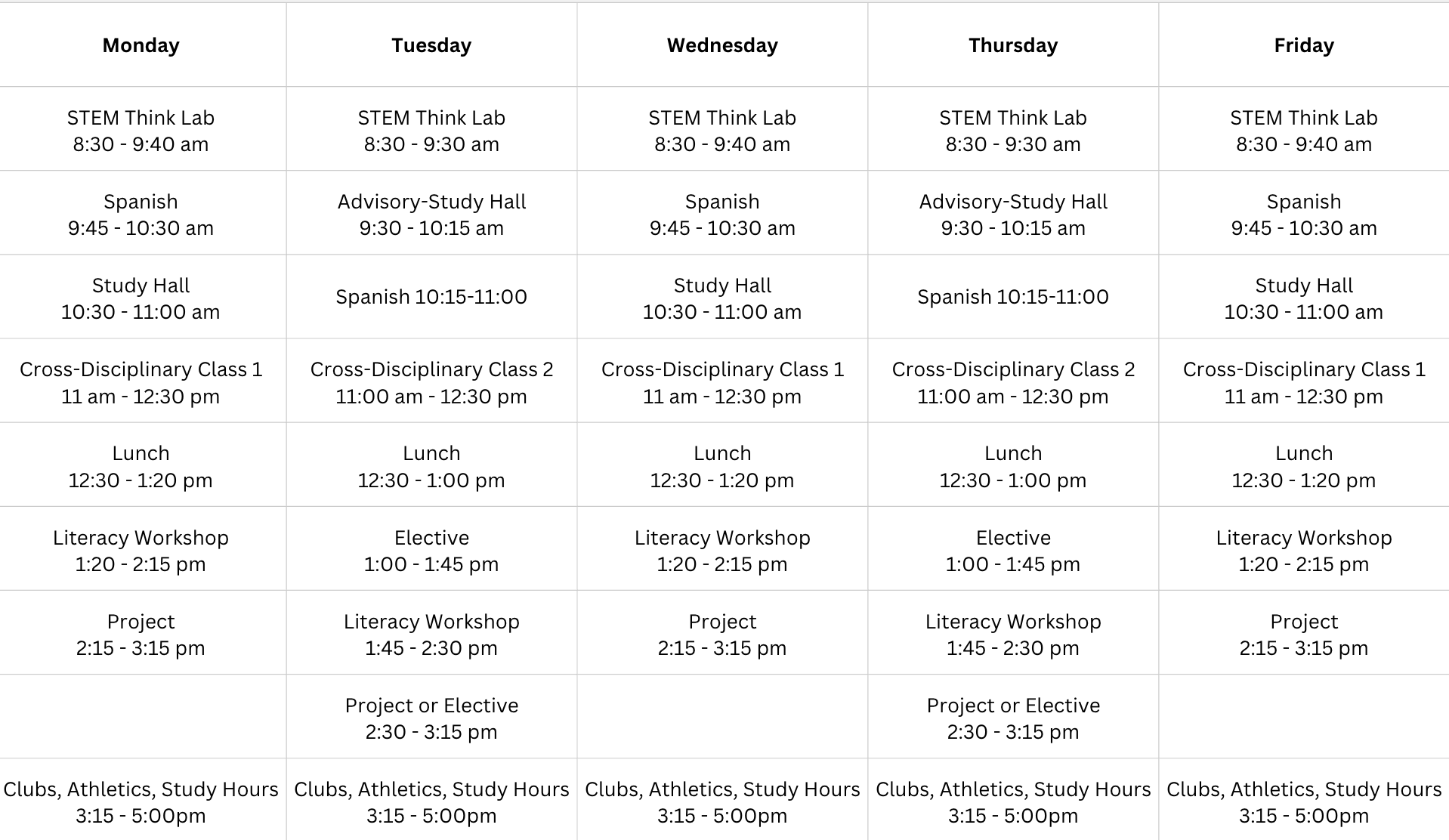
During each year of high school, students take interdisciplinary classes, writing workshops, STEM skills, electives, and they also have dedicated independent research project time. Each day includes a balance of direct instruction, collaborative discussion, and independent research, allowing students to build skills while applying them to meaningful work.
Moving Beyond APs
At Slate School, we prioritize depth of understanding, original thinking, and real-world application over standardized coursework. The movement for high schools to provide AP courses began in the 1950s. Today, there is a growing trend away from AP courses in schools. Longstanding institutions such as Choate, Andover, Exeter, Milton Academy, Sidwell Friends, Riverdale, among many others, have abandoned AP offerings. They cite a significant preference to have their faculty lead the direction for each course, as opposed to teaching a boxed curriculum with the sole learning achievement watered down to a score on a multiple choice test. Colleges no longer seek numbers of AP courses taken or AP scores, but rather universities are seeking students with intellectual curiosity and rigor that goes well beyond preparation for a multiple choice test.
All of Slate School’s courses offer opportunities for advanced learning. The typical Slate School class is modeled on the way we access and use knowledge in the real world. All classes are interdisciplinary, allowing students to engage fluently and fluidly in important skills of writing, effective communication, problem solving, collaboration, flexibility, critical thought, and scientific inquiry.
A Rich High School Journey
Slate School prepares students not only for college, but for a lifetime of joyful learning, curiosity, and impact. Through their 4 years at Slate High School, students develop:
A deep understanding of core disciplines
The ability to think critically and independently
A portfolio of meaningful work
A clear sense of their passions and purpose