Upper School Blog
From Factfulness to October Sky: Interdisciplinary Learning From Data, Texts, and Historic Perspectives
By Jennifer Staple-Clark, Founder and Executive Director, and Math & Science Specialist
In Think Lab in the Upper School at Slate School, students use mathematics and science to investigate questions that emerge from data, texts, and historic perspectives. Students are deeply engaged in interdisciplinary mathematical and scientific learning rooted in real-world problem solving. The course nurtures students to think mathematically and scientifically about authentic issues, while cultivating their ability to apply understanding to original ideas, pursuits, and solutions.
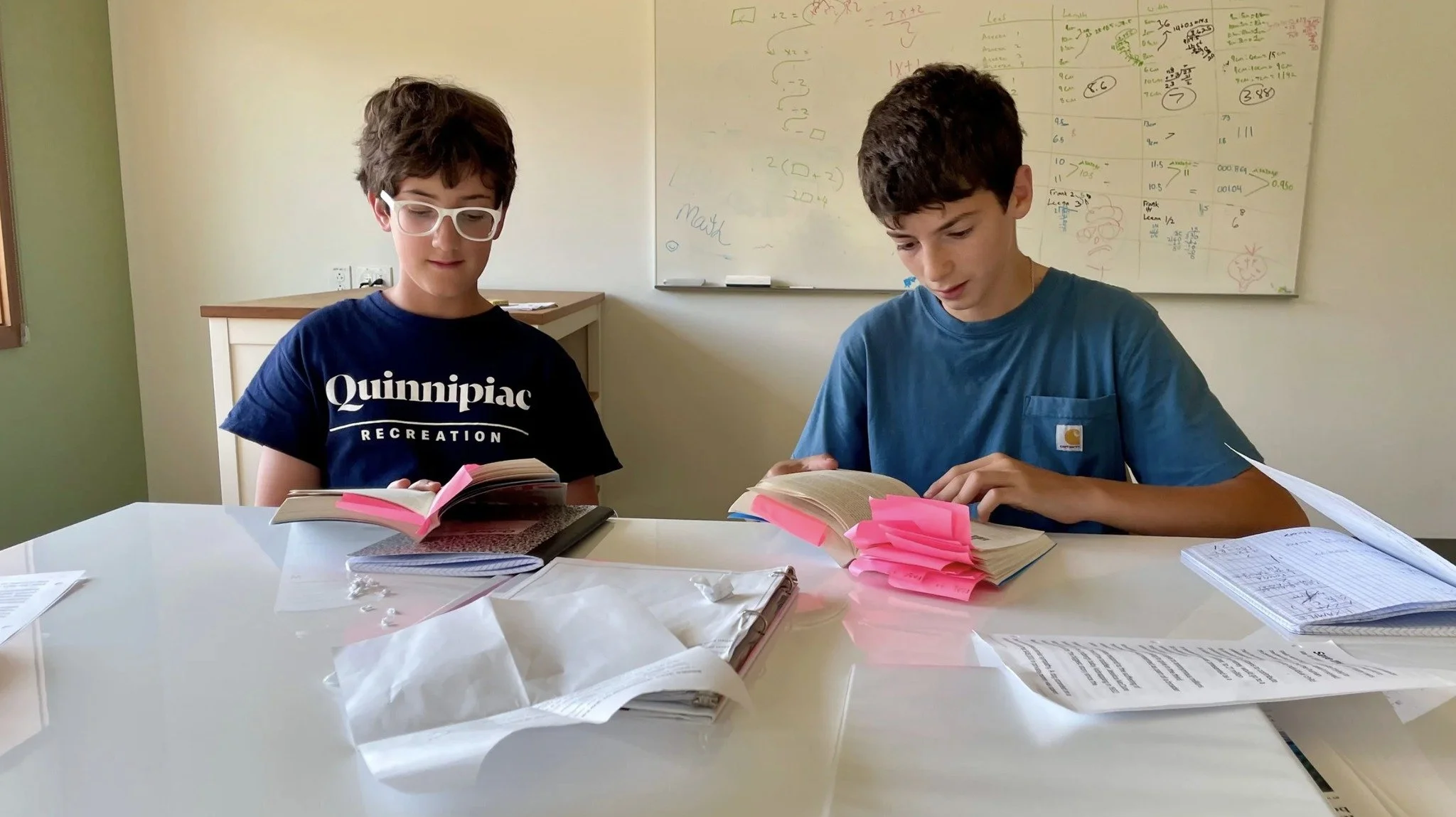
During the first trimester of one of our 8th grade Think Lab courses, my students began with a close reading and analysis of Factfulness by Hans Rosling, a book that emphasizes statistical thinking and a fact-based worldview. With its abundance of graphs and real-world data, the book provided a meaningful framework for applying statistics to real-world contexts. This foundation guided much of their learning, connecting statistical concepts to linear equations and reinforcing how mathematics plays a critical role in understanding the world
Students demonstrated strong proficiency in interpreting Rosling’s data representations. They explored key statistical ideas such as samples versus populations, standard deviation, interpreting data representations and features of distributions, linear vs. non-linear patterns, lines of best fit and linear equations, bias and how it affects results, and making predictions based on data. Applying Rosling’s perspective, students became fluent readers of complex graphs, recognizing misleading representations and identifying appropriate statistical questions. The dive into Factfulness culminated in writing a robust and thoughtful critique about the book.
Inspired by student interest in astronomy, the interdisciplinary Think Lab next turned to a multi-month exploration of the book October Sky by Homer Hickam, which connected key concepts in energy, renewable resources, physics, astronomy, and algebraic thinking. Students convened for frequent Harkness conversations about the book during class, as they thought about what happened and why in this inspiring memoir by a NASA engineer. Students especially discussed the role of the author’s intellectual curiosity, grit, and the benefits of failure and perseverance in overcoming immense challenges.
The book also offered a human-centered approach to renewable and non-renewable energy sources. Through a variety of readings, a documentary, graphs, data sets, as well as Homer Hickam’s narrative about a coal mining town in the 1950s, students examined national and global energy production and consumption over time. Students considered energy needs, access, and costs around the world, including in developing countries where electricity remains inaccessible to many. Their questions led to viewing a TED Talk called, “We Care Solar Suitcases: Sunlight Saving Lives”, which introduced them to Laura Stachel’s innovative solar suitcase designed to bring electricity to healthcare clinics in low-resource settings. Students developed questions for Laura Stachel and were inspired by a live Zoom conversation with her, during which they learned more about how solar energy works, including the mechanics behind her invention and the real-world challenges of implementation. After synthesizing multiple perspectives on energy, students applied evidence to write thoughtful persuasive essays addressing the future of energy.
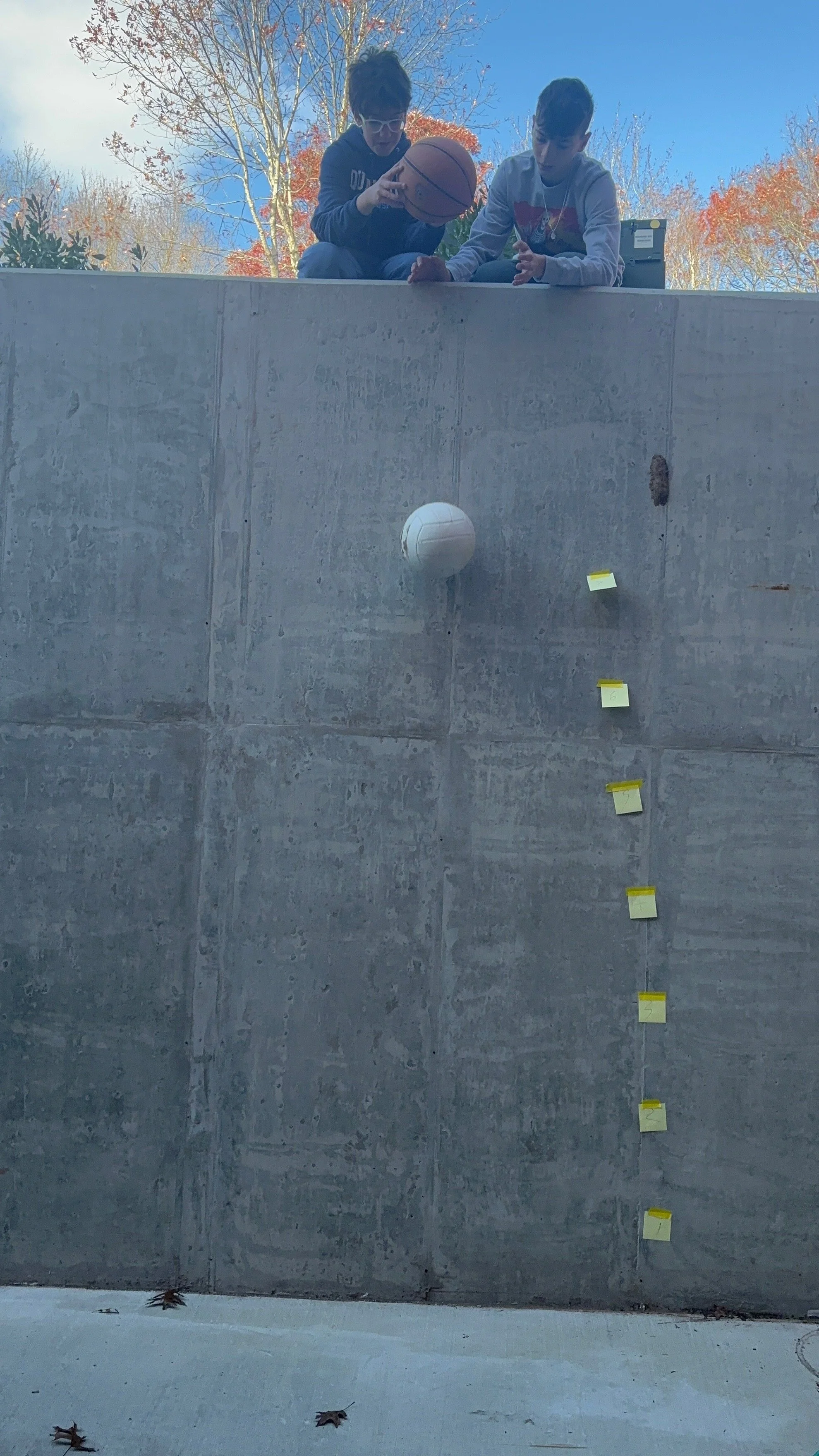
Hickam’s narrative offered an introduction to many topics that students explored deeply. For example, as the book’s characters discovered Newton’s Third Law in their quest to launch rockets, our students learned about all three of Newton’s Laws of Motion and were tasked with designing an experiment to demonstrate Newton’s Third Law. They developed a well-conceived experiment in which they identified and set up a testing site, determined controls and variables, and conducted trials by dropping sports balls onto each other to identify equal and opposite forces. With the copious data that they collected and entered into an Excel sheet, they applied algebraic modeling skills to interpret, calculate, and analyze patterns of objects in motion, including potential energy, kinetic energy, acceleration due to gravity, average velocity, and terminal velocity.
Beyond the many scientific and mathematical concepts introduced by Hickam in the book, students also identified a topic related to October Sky for their own end-of-trimester research paper. Student topics included rocket fuel and aerospace regulations and space law.
Student experiences through these powerful books exemplify some of the primary goals of Think Lab: empowering students to wonder and ask meaningful questions, nurturing deep engagement in learning, offering opportunities to analyze historic and contemporary scientific perspectives, and applying knowledge to design original experiments and solutions. Students carry with them not only skills and content knowledge, but the grit and inquiry needed to engage thoughtfully and creatively with complex questions and systems.