Upper School Blog
DNA & Human History: Where Science Meets the Human Experience
By Jennifer Staple-Clark, Founder and Executive Director, and Math & Science Educator
What does our DNA reveal about who we are, where we come from, and how we became human? In our interdisciplinary 9th grade course, DNA & Human History, our students explore cellular evolution, ancient human migrations, DNA sequencing, and the history and future of genetic discoveries. Through reading The Code Breaker by Walter Isaacson and Human Errors by Nathan Lents, students investigate the possibilities and imperfections of human biology. This course blends genetics, cancer biology, and medicine with history, anthropology, and ethics. Students interrogate questions of cellular and human evolution, as well as the future of medicine and genetic engineering.
At Slate School, biology comes to life through real-world applications and meaningful connections with experts in the field. Learning is driven by curiosity, enriched by expert perspectives, and grounded in authentic applications. As students delve into biological concepts through visual representations, they notice and wonder. Before working toward fluency in these concepts, students first share their noticings and wonderings and engage in conversations with their classmates. Often, their questions are so robust that there are currently no known scientific answers. As we emphasize to students, these are the types of questions that scientists ask and then design experiments to investigate.
Our students regularly learn from scientists who bring medical case studies, professional experiences, and real-world perspectives into the classroom. Our students learned about the intricacies of DNA replication, transcription, translation, and protein synthesis. They learned about how these processes function normally, as well as what happens when they go awry and affect human health. Endocrine surgeon and oncologist Dr. Glenda Callender joins our class monthly to ground students’ scientific understanding in medical case studies. At the beginning of October, she conveyed the human side of DNA mutations. She shared the case study of a patient with a RET mutation who presented with neuroendocrine tumors. She shared the amino acid pinwheel, and our students saw how a single point mutation could alter the amino acid sequence of a protein, contributing to the patient’s disease. Students saw images of the tumors removed as well as pathology slides.
Our students next had a Zoom meeting with Dr. Diana Mandelker, a pathologist and Director of the Diagnostic Molecular Genetics Laboratory at Memorial Sloan Kettering. She, too, has done research on the RET mutation from the perspective of a pathologist, and she shared case studies of patients with whom she has worked. She also explained her role as a pathologist and showed images of the DNA sequencing technology that she uses daily in her laboratory to uncover details about patients’ cancers.
As our students learn about illness and disease, they also consider the human experience behind the science. Our students were fortunate to speak via Zoom with Natasha Rabinowitz Steele, Clinical Assistant Professor of Medicine at Stanford School of Medicine, who wrote the moving piece "The Patient Resident" in The New England Journal of Medicine in 2022. Our students read this article in advance of the conversation. Natasha is both a physician and a cancer survivor, and our students found her work deeply thoughtful and her words beautiful. She spoke about how all of our experiences — both wonderful opportunities and difficult challenges — can give us meaning, energy, and purpose.
Among the many questions our students asked was whether a doctor can truly understand a patient without having experienced the same illness. Natasha responded with a question of her own: Can any of us ever fully understand another person's experience? She explained that while no one can completely understand another person's experience with cancer, her own experience has given her insight into how to ask better questions to understand a patient's perspective. She emphasized that medicine is, in many ways, about asking open-ended questions and listening deeply to the answers. Natasha related her experience back to what we do at Slate School, and she said that it's important to "learn how to ask questions to better understand."
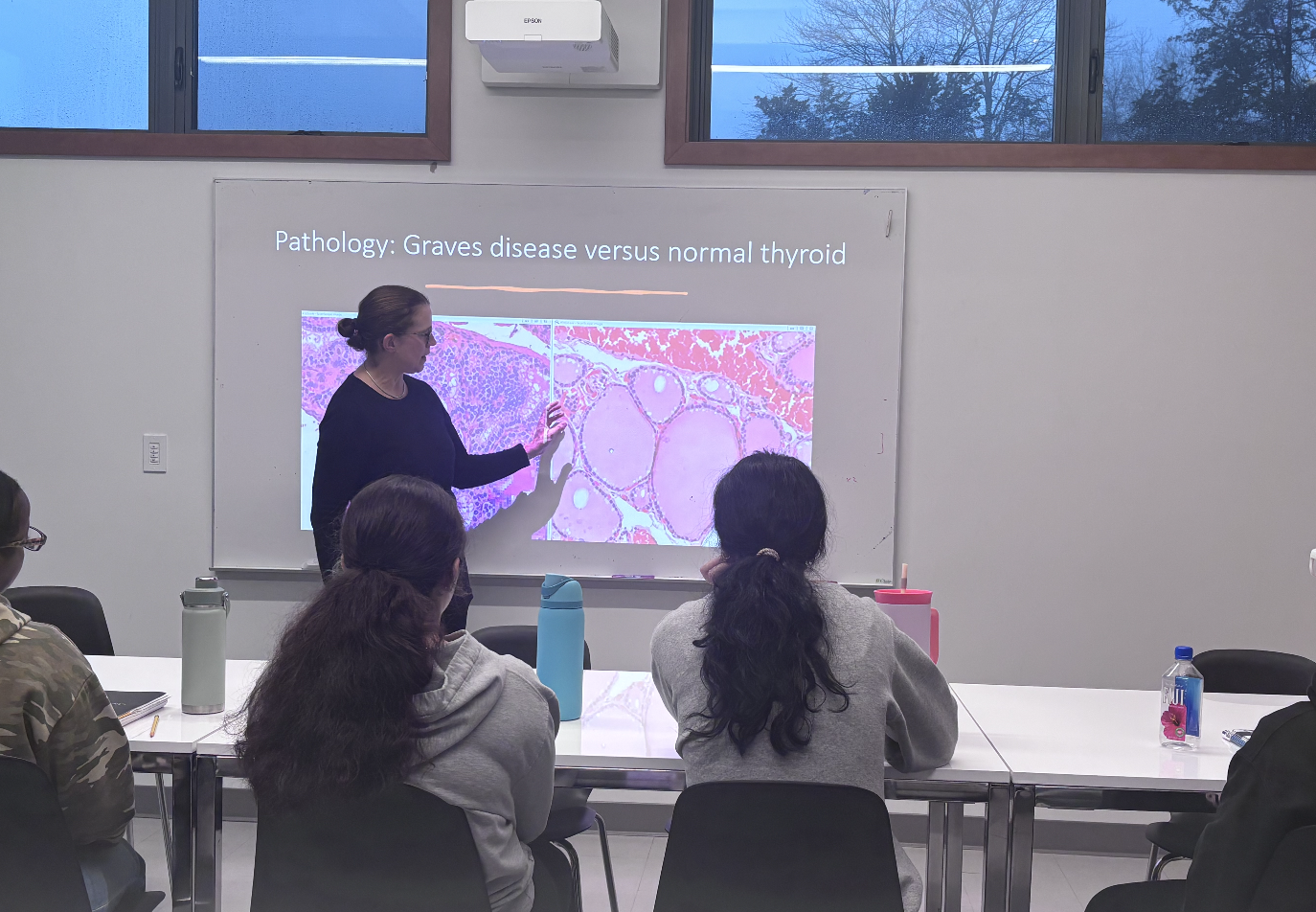
Our students also delved into cellular organelles and organelle dysfunction. Dr. Glenda Callender returned in early November, and she shared a compelling case study of a patient with Graves' disease, an autoimmune thyroid disorder that affects the body's metabolism and energy use. Students were able to see images from the patient's thyroid surgery, along with pathology slides of the thyroid cells. Through this real-world case, students deepened their understanding of mitochondrial inner and outer membranes, ATP production, and the connection between cellular energy processes and human health and disease.
Along the way this trimester, our students read The Code Breaker by Walter Isaacson, a book that traces the trajectory of Jennifer Doudna’s groundbreaking work in developing CRISPR gene-editing technology. They had ongoing Harkness conversations about this book. At the Upper School, we embrace the Harkness Method, which is a cornerstone of learning across all disciplines, fostering a culture of inquiry, dialogue, and collaborative discovery. Our students engage with books, articles, and primary documents in advance, and they bring their own noticings and wonderings to the table. Through student-driven discussions, they delve deeply into the readings, interrogate ideas, challenge assumptions, consider multiple perspectives, and build upon one another’s insights. Rather than simply receiving information from a teacher, students take an active role in constructing knowledge, with teachers serving as facilitators who guide and enrich the conversation. This process nurtures students’ critical thinking, intellectual curiosity, careful listening, and the ability to articulate and defend ideas with evidence. Each discussion transforms learning into a shared intellectual endeavor as students collectively deepen their understanding.
Our students also wrote an essay about what it means to be human, and the power and limitations of genetic knowledge. They discussed how DNA research is transforming our understanding of human health, disease, and genetic differences. They analyzed scientific readings and the expert conversations to present a clear thesis statement. They also considered what new possibilities, responsibilities, and ethical questions emerge as our ability to understand and use genetic information improves.
In addition to exploring the wonders and imperfections of the human body and the present and future of medicine, students are also reading Human Errors by Nathan Lents. His thesis is that many of the human body’s imperfections are consequences of its evolutionary history. Our students interrogated the author’s choices and wondered whether some apparent imperfections might actually protect us from more serious problems. Perhaps a trait that we view as a flaw, such as the inverted structure of the human retina, might actually prevent a greater problem, they suggested. They also considered positive, neutral, and negative mutations, and how their prevalence and effects can change over generations and throughout human evolutionary history.
Our students are discovering that understanding DNA is about far more than understanding the molecular foundations of life. They have explored evolutionary history, investigated the complexities of the human body and human health, and considered the ethical questions that develop as scientific knowledge advances. Through conversations with physicians, engagement with books and articles, and inquiry-driven conversations, students question, analyze, and consider the implications of DNA in human history. Most importantly, they are discovering that science is not simply a body of established knowledge, but an ongoing process of asking questions, exploring possibilities, and seeking deep understanding about human health and history.